Social Identity and Nature of Science Knowledge at the Undergraduate Level
Liv Taylor, Mandana Sobhanzadeh, and Nicholas Strzalkowski, Mount Royal University, Canada
Copyright 2025 The Author(s). CC-BY License 4.0.This is an open access work distributed under the terms of the Creative Commons Attribution 4.0 International License, which permits sharing and adaptation with appropriate credit.
Abstract
Science literacy is essential for informed participation in modern society, and undergraduate education plays a critical role in fostering science literacy among science and non-science students. One important component of science literacy is understanding the nature of science (NOS), yet traditional NOS frameworks have been critiqued for oversimplifying scientific practice and neglecting its social and cultural dimensions. While social identity is known to influence student academic engagement and performance, little is known about how identity factors such as gender, age, program and level of study, being a visible minority, or parental education influences NOS beliefs. In this study, 272 undergraduate students from a Canadian liberal arts university completed an online questionnaire assessing NOS knowledge. Students generally demonstrated a solid understanding of NOS, though their comprehension of scientific methods is limited. No significant differences in NOS beliefs were found across social identity groups, but non-science majors were more likely to report uncertainty in their responses compared to science majors. These findings suggest that traditional NOS measures may fail to capture the nuanced ways that social identity shapes science understanding, emphasizing the need for justice-oriented approaches to NOS education.
Keywords: nature of science (NOS), social identity, science education, science literacy, undergraduate education
INTRODUCTION
Modern advancements in science and technology increasingly demand that individuals become scientifically literate to fully engage in society. A solid understanding of science facts and processes shapes cultural experiences and informs many personal, economic, and democratic decisions. In today’s information landscape, individuals are exposed to vast amounts of both scientific information and misinformation. Distinguishing between science and pseudoscience can be challenging, even for those with formal science training (Impey, 2013; Strzalkowski & Sobhanzadeh, 2023). A primary goal of science education is to promote and advance science literacy by equipping students with the knowledge and critical thinking skills that they need to evaluate information and make evidence-based decisions (Holbrook & Rannikmae, 2007). Science literacy is crucial for many daily decisions, for democratic engagement, and for the appreciation of science as a cultural force (Snow & Dibner, 2016; Yacoubian, 2018). Given its personal, societal, and cultural significance, science literacy is an essential educational goal and a cornerstone of modern citizenship.
While no universally accepted definition of science literacy exists, it is generally understood that a scientifically literate person can distinguish between scientific and non-scientific information, apply scientific knowledge to problem solving, and critically evaluate scientific information (Norris & Phillips, 2003). Practical science literacy, which enhances decision making and enriches experiences, evolves over time and varies between individuals. Therefore, science education must address the current needs and circumstances of individual students while providing a framework that is broadly applicable to diverse classrooms. Scientific literacy is particularly relevant for making decisions and informing beliefs about issues related to the natural world, where science offers more reliable insights than political or religious ideologies (Drummond and Fischhoff, 2017). For instance, the decision to vaccinate oneself and one’s children or vote for stricter regulation on climate change are polarizing issues with significant societal consequences. Educators and policymakers therefore face the challenge of encouraging individuals to acquire and apply scientific knowledge to their decision-making frameworks. For many, formal education from elementary school through post-secondary provides the foundation of scientific literacy. However, lived experiences outside the classroom also shape an individual’s understanding of science.
Central to the promotion of science literacy is an understanding of the nature of science (NOS), which traditionally seeks to describe the epistemology of science, scientific inquiry, and the values and beliefs inherent in the development of scientific knowledge (Lederman, 1992; Lederman et al., 2013). In simple terms, NOS refers to how science works—how scientific knowledge is generated, applied, and refined over time. It includes understanding that science knowledge is based on evidence, can change with new discoveries, and is influenced by human creativity and cultural context. NOS has long been recognized as a foundation of science literacy, as it helps students navigate the complexities of scientific information and the increasing amounts of misinformation in modern society (Snow & Dibner, 2016). NOS is typically assessed through two main components: NOS knowledge (NOSK) and NOS inquiry (NOSI). NOSK refers to the knowledge gained from science practices (i.e., the results of “doing science”), while NOSI pertains to understanding of how science inquiry works (i.e., scientific methods and understanding “how science is done”) (Lederman & Lederman, 2019; Woitkowski & Wurmbach, 2019; Woitkowski et al., 2021). Despite their prominence, traditional NOS frameworks have faced critiques regarding their limitations in adequately reflecting the complexities of scientific inquiry and their role in perpetuating epistemic inequities in education (Allchin, 2011; Rudolph, 2000; Stroupe et al., 2024). This has led scholars to advocate for more holistic and justice-oriented approaches to NOS, such as a “Whole Science” framework, which integrates social and cultural dimensions into science education (Allchin, 2011). Furthermore, Woitkowski and Wurmbach (2019) suggest that NOS is often learned through a “hidden curriculum”—the implicit experiences and identity-forming processes students encounter during their education. Unfortunately, this hidden curriculum frequently falls short in fostering adequate NOS beliefs (Lederman et al., 2013).
Researchers at a German university investigating NOS views found both university faculty and students to possess adequate views on the development and justification of scientific knowledge (Woitkowski & Wurmbach, 2019; Woitkowski et al., 2021). However, they also found confusion regarding the variability of scientific methods and the inherent uncertainty of scientific knowledge. Notably, senior undergraduate students (fourth semester and beyond) demonstrated a weaker understanding of the degree of certainty to be expected of scientific findings compared to their earlier-semester peers, despite having a better grasp of scientific methods (Woitkowski et al., 2021). Similarly, science literacy of US undergraduates was not shown to improve after taking three university-level science courses, and science literacy levels overall remained stagnant over two decades, from 1988–2008 (Impey, 2013). This trend was also observed in Canadian students, where a single science course had little impact on improving science literacy (Cartwright et al., 2020). These findings suggest that undergraduate science education, across various educational contexts, is insufficient for effectively conveying or advancing NOS concepts.
A critical factor for developing science literacy is intrinsic motivation—the perceived value students place on learning science (Ustun, 2024). Attitudes and beliefs about science play a crucial role in shaping this intrinsic motivation, which, in turn, influences students’ science achievement and literacy (Buxner et al., 2018). There is growing recognition that NOS needs to be contextualized and integrated into interdisciplinary learning experiences that emphasize real-world issues (Allchin, 2011; Duschl & Grandy, 2013; Rudolph, 2000). Although it is difficult to quantify the effect of life experience on attitudes or beliefs towards scientific knowledge, Snow and Dibner (2016) emphasize that “individuals are nested within communities that are nested within societies—and as a result, individual literacy skills are limited or enhanced by these multiple, nested contexts” (p. 1). Thus, to enhance science literacy and NOS knowledge through undergraduate education, it is essential to explore the social identities shaped by these contexts and understand potential barriers.
Social identity, which refers to an individual’s self-concept based on perceived membership in social groups, such as gender, age, or race (Terry et al., 1999), has been shown to influence attitudes and beliefs about science (Chung & Milkoreit, 2023; Greenfield, 1996; Miller et al., 2006). Social identity is known to affect how students approach learning, which, in turn, impacts academic performance (Bliuc et al., 2011; Makarovs & Allum, 2023). For example, first-generation students, those whose parents did not attend university, tend to have lower academic performance, including in science courses (Eveland, 2020; Verdin & Godwin, 2015). Additionally, research indicates that female students demonstrate higher levels of science literacy than their male peers (Bahtiar et al., 2022), while Black and Hispanic students, despite similar interest in science, tend to exhibit lower levels of science literacy compared to other groups (Allum et al., 2018). While research links social identity to science engagement, little is known about how it shapes specific epistemological understanding, such as NOS.
This study explores undergraduate students’ NOS beliefs in the context of social identity factors, including level and program of study, gender, age, minority status, and parental education. Although efforts to promote science literacy and NOS understanding have been integrated into general education curricula at our institution, evidence suggests that undergraduate education still falls short in fostering science literacy concepts for all students (Strzalkowski & Sobhanzadeh, 2023). This gap may not be evenly distributed, and students’ understanding of NOS may be shaped by their social identity, academic background, and interests. The student participants in this study complete general education courses, regardless of discipline, across several thematic clusters, including Numeracy and Science Literacy; Values, Beliefs and Identity; Community and Society; and Communication. Conducting this study in the context of a liberal arts institution provides a valuable opportunity to examine how NOS understanding varies for students with diverse academic and personal backgrounds, revealing who is and is not being effectively reached by science literacy efforts. While traditional NOS measurements and frameworks serve as the foundation for this investigation, we adopt them critically, recognizing their potential to obscure the diverse perspectives and experiences shaped by social identity. This study aims to contribute to ongoing efforts to understand and reform science education to better reflect the diversity and complexity of science knowledge and inquiry.
Methods
Participants
This study was conducted at Mount Royal University, a publicly funded Canadian liberal arts undergraduate institution. Undergraduate students were recruited from two groups: those enrolled in a first-year multi-section general education math and science course taken by students from across disciplines (Scientific and Mathematical Literacy for the Modern World, GNED 1101) and those enrolled in fourth-year, 400-level courses across all university departments. Student were categorized into different identity groups based on the following criteria: level of study (junior [first or second year], senior [fourth year or higher]), program (science, non-science), gender (man, woman, other), age (<23, ≥23), minority status in Canada (visible minority, non-visible minority), and parental university attendance (first-generation, second-generation). This study presents a novel subset of data collected as part of a broader science literacy experiment, with initial findings previously published (Strzalkowski & Sobhanzadeh, 2023). All participants provided written informed consent prior to data collection, and the study protocol was approved in advance by our university ethics board.
The Questionnaire
Participants completed a custom online questionnaire (Qualtrics) consisting of 73 multiple-choice questions across several themes: personal characteristics, attitudes and engagement, foundational knowledge, nature of science (NOS), and science/pseudoscience belief.
This study focuses on the personal characteristics and NOS questions adapted from Woitkowski et al. (2021), who developed their instrument on validated scales including Views of Nature of Science (VNOS), Views About Science Survey (VASS), and Colorado Learning Attitudes About Science Survey (CLASS). Questions were divided into two broad categories: NOS knowledge (NOSK) and NOS inquiry (NOSI). Within NOSK, subcategories include certainty of knowledge (NOSK-CRT), development of knowledge (NOSK-DEV), simplicity of knowledge (NOSK-SMP), and justification of knowledge (NOSK-JST). NOSI subcategories include the purpose of science (NOSI-PRP), scientific methods (NOSI-MET), and creativity and imagination (NOSI-CRE).
Woitkowski et al. (2021) dropped questions from their original questionnaire due to low discriminatory power, resulting in a final set of 38 questions. We further refined the questionnaire, resulting in a set of 20 questions, with two to four questions per subcategory. Participants rated each statement on a 4-point Likert scale, where 1 = “totally incorrect” and 4 = “totally correct.” We included a fifth option, “Not sure,” to capture participants’ confidence. The full set of NOS questions used in the present study are provided in the Appendix. Table 1 presents the distribution of questionnaire items with examples.
Table 1
Overview of the Testing Instrument
| ID | Scale | Items | Example Item |
|---|---|---|---|
| NOSK-CRT | Certainty of knowledge | 2 | Science, like humanities, cannot provide absolute true knowledge |
| NOSK-DEV | Development of knowledge | 3 | New discoveries can change what scientists think is true |
| NOSK-SMP | Simplicity of knowledge | 3 | The more complicated a scientific theory is, the higher its reputation is among scientists (–) |
| NOSK-JST | Justification of knowledge | 4 | In the sciences, new concepts can emerge from one’s own questions and experiments |
| NOSI-PRP | Purpose of the sciences | 3 | The goal of scientific theories is to explain natural processes |
| NOSI-MET | Scientific methods | 2 | Without results and data from appropriate experiments, no new scientific theories can be established (– |
| NOSI-CRE | Creativity and imagination | 3 | Creative thinking is incompatible with logic-based science (–) |
Note. Examples marked (–) are inverted. All test items can be found in the Appendix
Data Analysis
To aid in the interpretation of NOS scores, question scales were oriented such that higher scores on a 4-point scale represent more adequate NOS views. Following prior work (Woitkowski and Wurmbach 2019; Woitkowski et al., 2021), we used a pragmatic threshold of ≥3 on a 4-point scale to indicate “adequate NOS beliefs.”
We used the Kruskal-Wallis test with Dunn’s multiple comparisons to examine differences in NOS scores for the full sample (n=272) and between student identity groups: level of study, age, gender, visible minority status, and parental post-secondary education. The Kruskal-Wallis test, a nonparametric alternative to the parametric analysis of variance (ANOVA), was chosen due to the ordinal nature of Likert-type responses used in the NOS questionnaire. While Likert-scale data are sometimes treated as continuous, we opted for a more conservative approach given that the refined NOS questionnaire used in this study has not been independently validated. Internal consistency of the 20-item refined NOS questionnaire was assessed using Cronbach’s alpha, calculated using the online tool provided by Cogn-IQ (http://www.cogn-iq.org). All other statistical analyses and figure generation were performed using GraphPad Prism (version 9). Differences were considered statistically significant at P < 0.05.
Results
A total of 272 undergraduate students were recruited and completed the study. Table 2 provides the distribution of participants across identity groups. The questionnaire indicated good internal consistency, with a Cronbach’s alpha of 0.84, indicating that the items functioned cohesively as a measure of students’ NOS beliefs.
Table 2
Participant Identity Groups
| Identity group | Group (number of participants) | |
|---|---|---|
| Level of study | Junior (n=120) | Senior (n=119) |
| Program | Science (n=88) | Non-sciences (n=184) |
| Gender | Men (n=69) | Women (n=189) |
| Age | <23 (n=176) | ≥23 (n=93) |
| Minority status | Visible minority (n=109) | Non-visible minority (n=149) |
| Parent/guardian university attendance | 1st generation (n=86) | 2nd generation (n=174) |
Adequateness of Nature of Science Knowledge
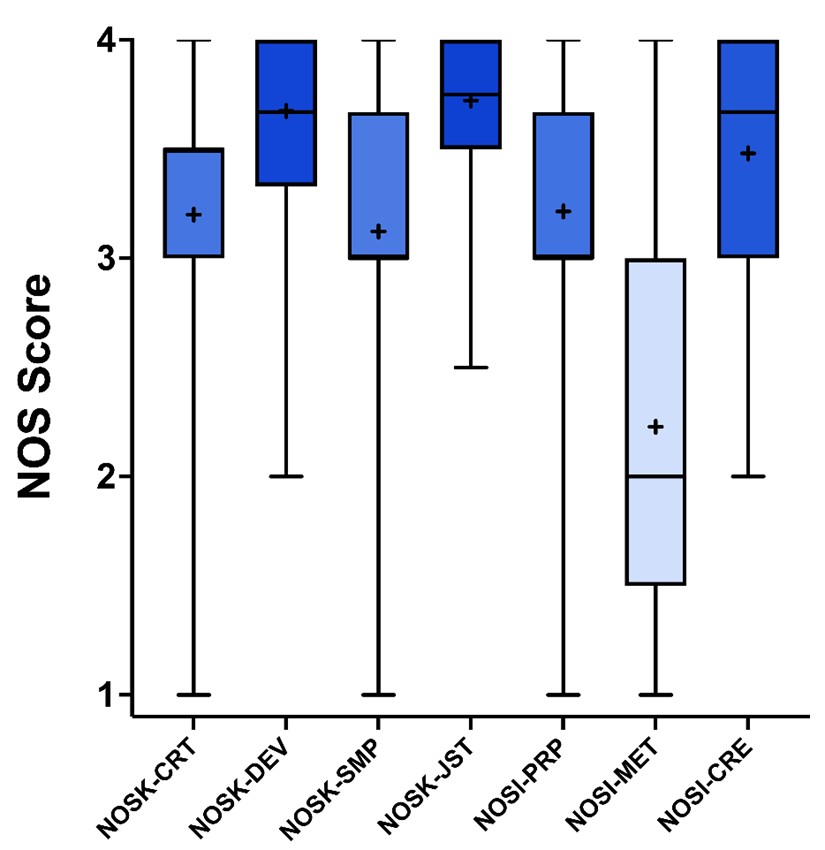
Figure 1 presents average scores across all 272 undergraduate student participants. A Kruskal-Wallis test indicated significant differences between scales H(6) = 627.6 P < 0.0001. Only the NOSI-MET (scientific methods) scale had a mean score below 3 (mean = 2.23, SD = 0.7916), which was significantly lower than all other scales (P < 0.0001). In contrast, NOSK-DEV (development of knowledge, mean = 3.68, SD = 0.3784) and NOSK-JST (justification of knowledge, mean = 3.72, SD = 0.3294) had the highest mean scores. Both were significantly higher than all the other subscales (P < 0.01) but did not differ from each other (P >0.9999).
Figure 1
Adequateness of Students’ Beliefs Across NOS Subcategories
Note. Higher scores correspond to more adequate beliefs. Boxes extend from the 25th to 75th percentile. Whiskers extend to the minimum and maximum of the data set. Horizontal line indicates scale medians and + indicates means. See Appendix for NOS subcategory questions.
In addition to NOSK-DEV and NOSK-JST, other scales do not show significant differences between them: NOSK-CRT (certainty of knowledge) and NOSK-SMP (simplicity of knowledge) (P = 0.9988), NOSK-CRT and NOSK-PRP (purpose of the sciences) (P > 0.9999), and NOSK-SMP and NOSK-PRP (P > 0.9999). Table 3 presents the percentage of responses within each scale considered adequate (score of 3 or 4 on a 4-point scale).
Table 3
Percentage of Participants in Each Identity Group With Adequate NOS (%)
| Group | Total | NOSK-CRT | NOSK-DEV | NOSK-SMP | NOSK-JST | NOSI-PRP | NOSI-MET | NOSI-CRE |
|---|---|---|---|---|---|---|---|---|
| All | 85 | 80 | 97 | 79 | 98 | 91 | 37 | 93 |
| Junior | 84 | 79 | 97 | 74 | 98 | 91 | 32 | 93 |
| Senior | 86 | 81 | 96 | 83 | 98 | 89 | 42 | 94 |
| Science | 85 | 79 | 97 | 82 | 99 | 90 | 31 | 95 |
| Non-science | 85 | 81 | 97 | 76 | 98 | 91 | 41 | 92 |
| Men | 85 | 75 | 98 | 75 | 98 | 85 | 46 | 94 |
| Women | 85 | 82 | 97 | 79 | 98 | 92 | 34 | 92 |
| <23 | 85 | 84 | 97 | 76 | 99 | 90 | 35 | 92 |
| ≥23 | 85 | 72 | 96 | 83 | 97 | 91 | 40 | 94 |
| Visible minority | 83 | 84 | 96 | 71 | 97 | 90 | 30 | 92 |
| Non-minority | 87 | 77 | 97 | 84 | 98 | 91 | 42 | 94 |
| 1st Gen | 86 | 83 | 98 | 79 | 98 | 89 | 38 | 92 |
| 2nd Gen | 85 | 78 | 96 | 79 | 98 | 91 | 38 | 94 |
Note. Shading shows low percentages in dark red to high percentages in dark blue with white indicating more central percentages.
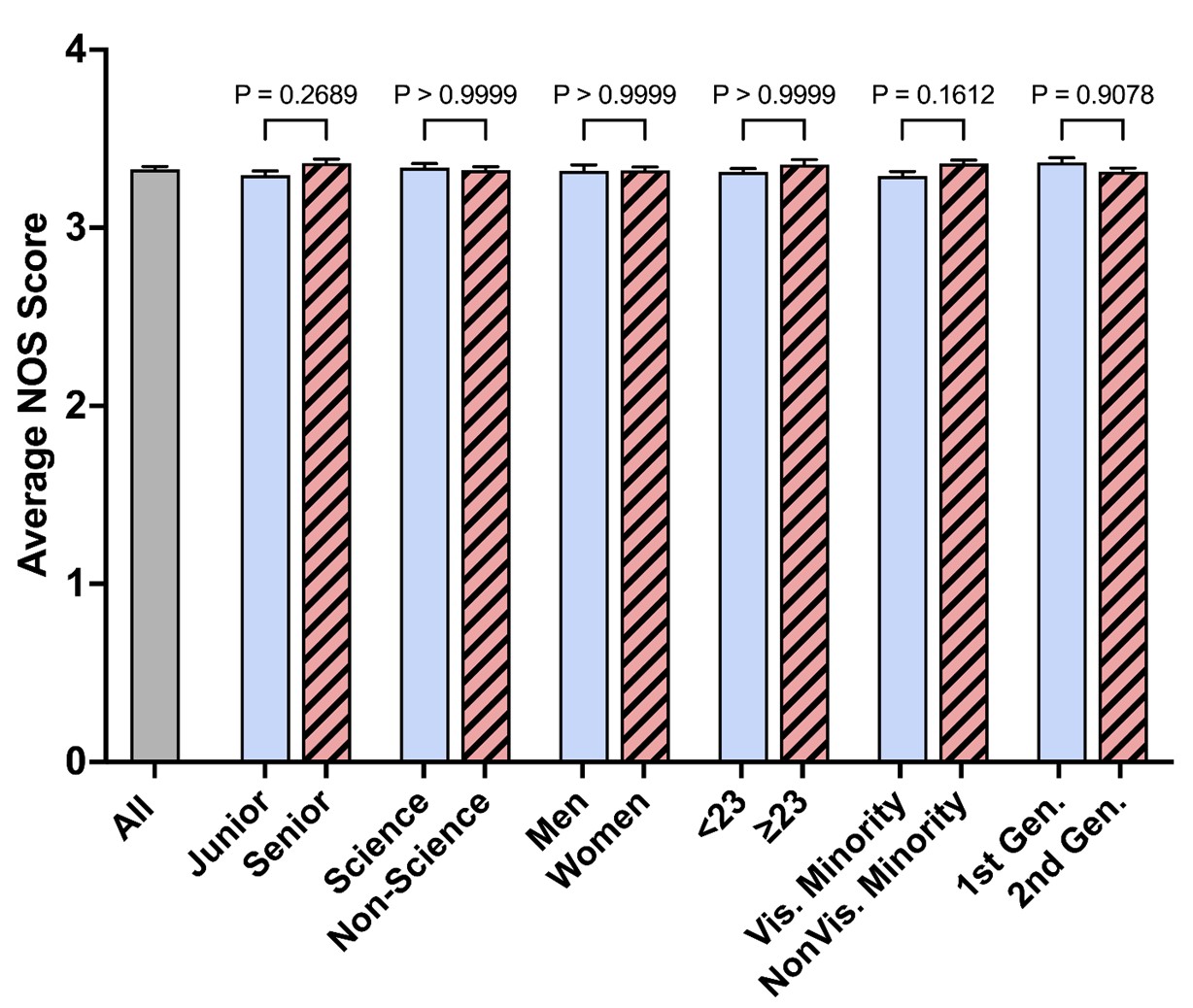
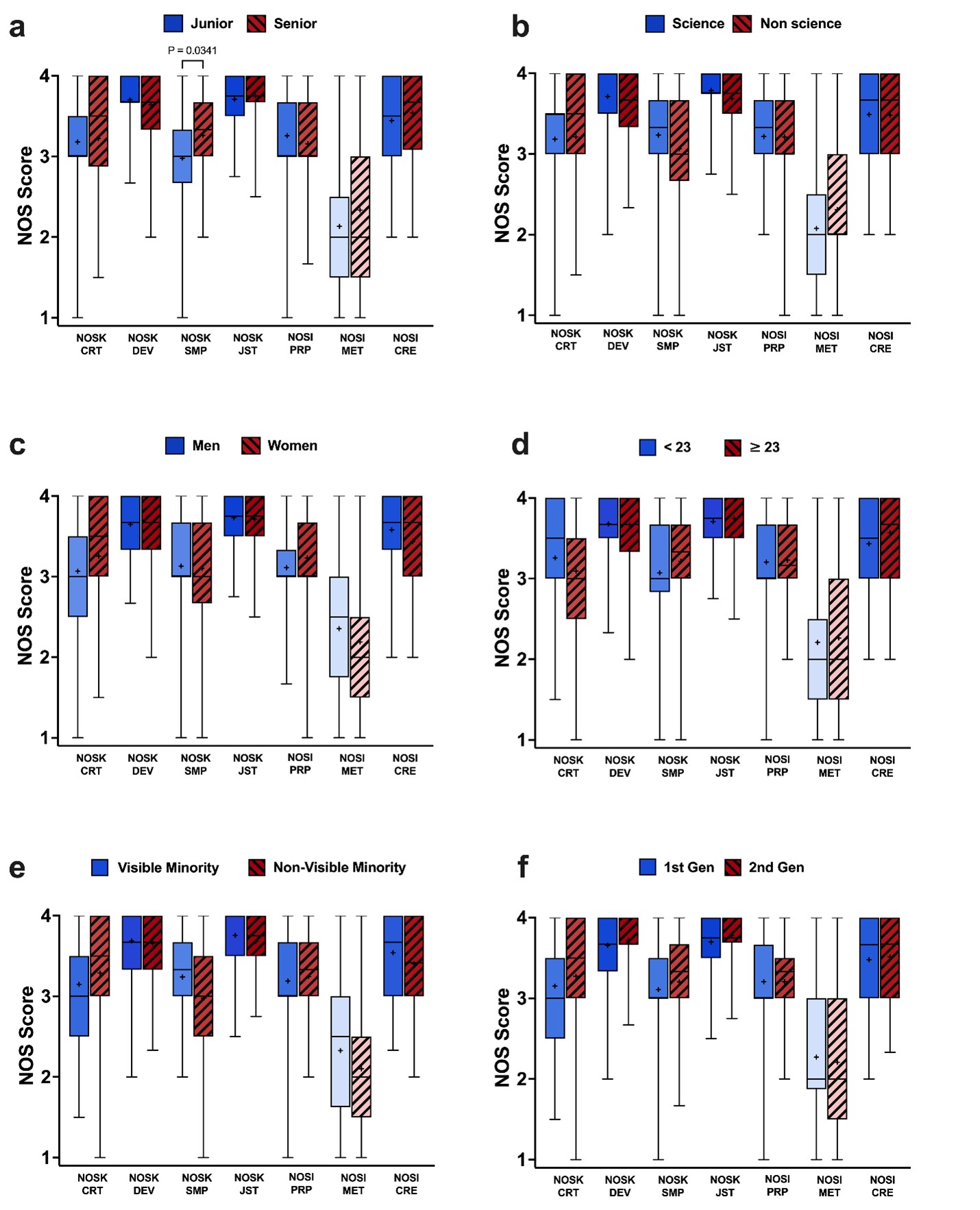
When comparing average NOS scores across different student identity groups, we did not find significant differences (H[11] = 13.07, P = 0.2887) (Figure 2). The only significant social identity difference appeared between junior and senior students, with senior students showing more adequate beliefs in the NOSK-SMP (simplicity of knowledge) subcategory (P = 0.0341) (Figure 3.A). No significant differences in NOS beliefs were found between science and non-science students, men and women, students younger than 23 and 23 and older, visible minority and non-visible minority students, or first-generation and second-generation students across all NOS subcategories (Figure 3).
Figure 2
Average NOS Scores Across Student Identity Categories
Note. Higher scores correspond to more adequate beliefs. Significant differences in NOS scores were not observed between any student identity groups (P = 0.2887).
Figure 3
Adequateness of Students’ Beliefs Across Student Identity Groups
Note. Student identity groups are arranged as follows: a) level of study, b) program of study, c) gender, d) age, e) minority status, f) parental education. Higher scores correspond to more adequate beliefs. Boxes extends from the 25th to 75th percentile. Whiskers extend to the minimum and maximum of the data set. Horizontal line indicates scale medians and + indicates means. See Appendix for NOS subcategory questions.
Confidence of NOS Knowledge
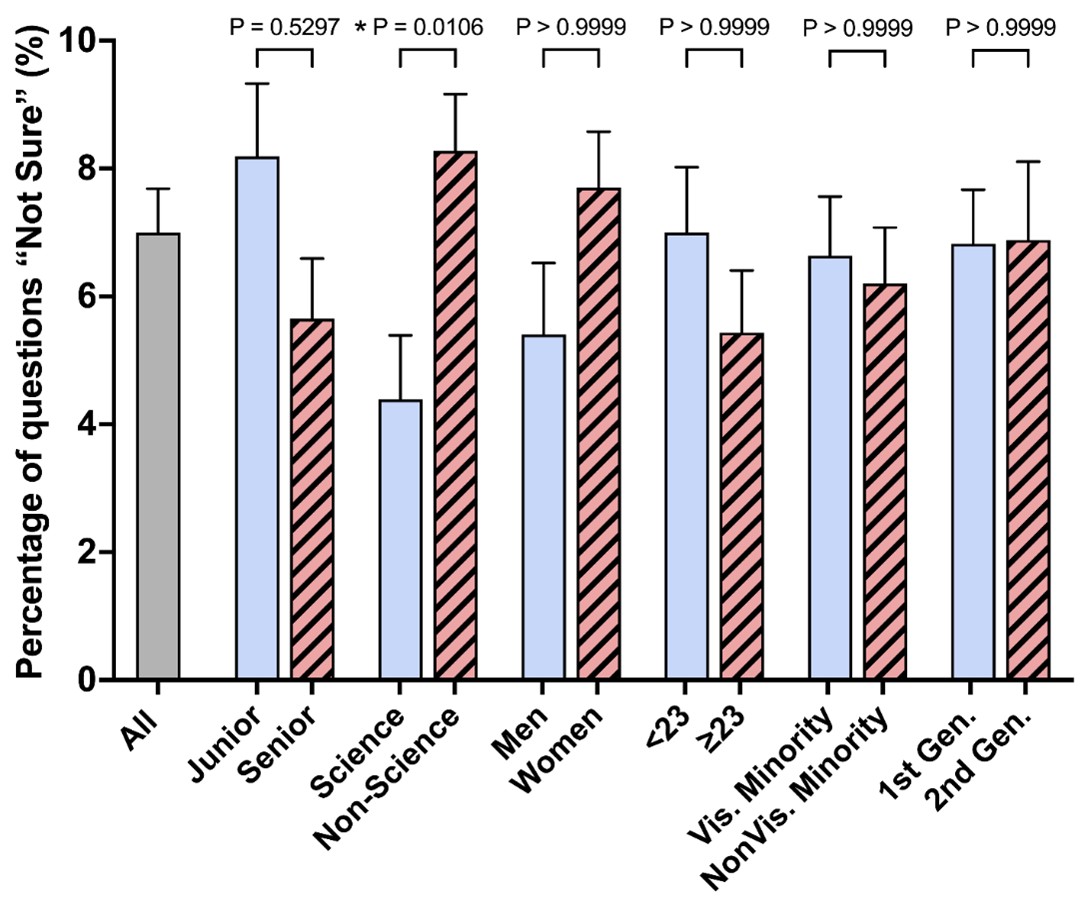
We assessed confidence in NOS knowledge by comparing the percentage of “Not sure” responses across identity groups. A Kruskal-Wallis test with Dunn’s multiple comparisons revealed that non-science students selected “Not sure” significantly more often than science majors (P = 0.0106). No significant differences were found between any other group in the dataset (Figure 4).
Figure 4
Percentage of Questions Answered as “Not Sure” Across All Participant Groups
Note. A significant difference in the average number of questions answered as “Not sure” was found between science and non-science students (P= 0.0106). No other significant differences between participant groups were observed.
Discussion
The purpose of this study was to investigate NOS beliefs of Canadian liberal arts undergraduate students and assess the influence of student identity factors on these beliefs. We modelled our approach after Woitkowski and colleagues (2019, 2021), who developed and administered an NOS questionnaire to both university professors and undergraduate students. Our findings indicate that, overall, students demonstrated adequate NOS knowledge, with particularly high scores in the subcategories of knowledge development (NOSK-DEV) and justification (NOSK-JST). However, consistent with previous studies, we found that students struggled with understanding scientific methods (NOSI-MET) and core component of NOS inquiry (Woitkowski et al., 2021). This suggests that undergraduate students across academic and other social identities may lack a comprehensive understanding of how scientific knowledge is produced and validated. Contrary to our expectations, identity characteristics such as program and level of study, age, gender, visible minority status, or parental education did not significantly impact NOS beliefs, suggesting limited influence of these factors on NOS knowledge development. These findings align with critiques of traditional NOS frameworks, which have been criticized for oversimplifying scientific practices and failing to reflect the diverse, complex, and dynamic nature of scientific inquiry (Allchin, 2011; Duschl & Grandy, 2013; Rudolph, 2000).
Previous research indicates that social identity characteristics, such as parental education, gender, and race, can influence academic performance, science anxiety, attitudes towards science, and likelihood of perusing STEM degrees (Allum et al., 2008; Bahtiar et al., 2022; Eveland, 2020; Greenfield, 1996; Nix & Perez-Felkner, 2019; Verdin & Godwin, 2015). Our findings, however, did not reveal differences in average NOS scores across any of our tested social identity groups. The only exception was that senior students scored higher than junior students in the simplicity of knowledge category (NOSK-SMP, P = 0.0341). This suggests that junior students may overestimate the complexity of scientific theories or inappropriately equate complexity with quality. Overall, we conclude that program of study, gender, age, visible minority status, and parental education have minimal impact on NOS beliefs as measured in this questionnaire, though level of study may play a minor role.
NOS is a key component of science literacy (Michel & Neumann, 2016) and a valuable framework for designing and evaluating science curricula (McComas et al., 1998). At Mount Royal University, a Canadian liberal arts institution, students from all disciplines complete general education courses that intend to foster critical thinking, interdisciplinary reasoning, citizenship, and science literacy through broad exposure to foundational knowledge areas. In this context, our findings raise important questions about whether general education science curricula is promoting a deep understanding of NOS. NOS beliefs influence cognitive processes involved in thinking and reasoning (Drummond & Fischhoff, 2017; Hofer & Pintrich, 1997) and contribute to a deeper understanding of scientific knowledge and methods. Viewing NOS both as a body of knowledge and as a framework for instruction offers value to curriculum development and supports educational goals aimed at enhancing science literacy. Given the broader societal benefits of science literacy, liberal education programs should seek to update NOS frameworks and strengthen student understanding of NOS in real-world contexts. The reliance on traditional declarative principles, such as science is empirical or science is tentative, although important foundational knowledge, may not on their own adequately help students critically evaluate scientific claims in everyday life (Allchin, 2011). The development of strong scientific reasoning is particularly valuable to help students navigate information and misinformation around contemporary science issues such as climate change and public health. Moving forward, NOS research and education should shift to more functional, context-based approaches and integrate skills like modelling, visual representations, argumentation, and collaborative inquiry (Duschl & Grandy, 2013).
An important consideration in interpreting our results are critiques that traditional NOS frameworks fail to capture the full diversity of science inquiry and may perpetuate inequalities in science education (Stroupe et al., 2024; Walls, 2016). By framing NOS as a static set of principles, such as science being empirical, tentative, or objective, researchers and educators risk excluding alternative ways of knowing that are shaped by cultural, historical, and social contexts (Walls, 2016). This limitation may help explain why our study did not find significant differences in NOS beliefs across social identity groups, despite prior research suggesting that race, gender, and parental education can influence science attitudes, engagement, and achievement (Allum et al., 2018; Brownlow et al., 2000; Eveland, 2020; Greenfield, 1996). Importantly, our study engages with this critique on two levels: first, in our use of a shortened NOS questionnaire (Woitkowski & Wurmbach, 2019; Woitkowski et al., 2021), and second, in how such frameworks continue to shape learning goals in science (general education) curricula. Because our assessment tool was developed in a traditional NOS framework, it may not have been sensitive enough to detect subtle identity-mediated ways students understand and engage with scientific knowledge. More broadly, our findings motivate a reconsideration of how NOS is defined and operationalized as a learning outcome, with greater attention to diversity and complexity of science knowledge and process.
Although our results show limited influence of social identity factors on NOS beliefs, previous studies report connections between these factors and science attitudes and performance, warranting further investigation. For example, non-science majors report higher science anxiety, potentially explaining differences in science engagement and performance (Udo et al., 2004). Despite expecting science majors to hold more accurate NOS beliefs than non-science majors, we found no significant differences. This may suggest that non-science majors acquire sufficient NOS knowledge through informal learning experiences or general education science courses. Prior research supports the role of informal science learning in fostering science engagement, regardless of program of study (Medina et al., 2014). However, it remains unclear whether students’ NOS beliefs reflect formal science instruction or informal science engagement. In our earlier work, we found comparable science engagement and pseudoscience belief levels among science and non-science majors (Strzalkowski & Sobhanzadeh, 2023). This aligns with the notion that NOS concepts may not be explicitly taught but are acquired indirectly. It is reassuring to see in our data generally adequate levels of NOS beliefs across all our student identity groups; however, our findings, alongside those of Woitkowski and Wurmbach (2019) and Woitkowski et al. (2021), emphasize the need for improved and more explicit NOS instruction.
While our data did not reveal significant gender differences in NOS belief, this contrasts with broader literature showing that gender-related factors such as motivation, confidence, and anxiety can contribute to science learning and performance. Gender differences in science literacy are often explained by variations in motivation, confidence, and anxiety rather than cognitive ability. Studies indicate that women, despite often showing higher motivation to learn science, may experience greater science anxiety, potentially affecting performance in science tasks (Mallow, 1994; Megreya et al., 2021; Morganson et al., 2010; Udo et al., 2004). Interestingly, higher science anxiety in girls/women is associated with higher science grades compared to less anxious boys/men (Brownlow et al., 2000; Megreya et al., 2021). Motivation to learn science is influenced by perceived relevance to career goals, a belief stronger among women (Glynn et al., 2007). However, high school girls often identify and engage with science less than boys, potentially reflecting gendered socialization that encourages boys to take science courses more than girls (Brownlow et al., 2000). These findings highlight the importance of connecting science to students’ career and personal goals and of addressing the impact of science anxiety on performance and attitudes.
Our study did not find age-related effects on NOS scores, contrasting with earlier studies where students aged 21–25 outperformed younger peers on a science literacy test (Medina et al., 2014). Attitudes towards science often decline with grade level (Akpınar et al., 2009; Greenfield, 1996), potentially due to accumulated negative experiences or stereotypes (Udo et al., 2004). In the US, Black and Hispanic adults report lower science confidence, less positive attitudes, and poorer literacy than their White peers (Allum et al., 2018). Other studies show that for Black but not White Americans, positive ingroup evaluation correlates with higher science literacy (Makarovs & Allum, 2023). First-generation students report lower levels of social and parental academic support, which may explain disparities in performance and career outcomes between first- and later-generation students (Eveland, 2020; Verdin & Godwin, 2015). While these findings suggest links between social identity and science engagement, our study did not find such variations in NOS beliefs.
We also assessed NOS confidence by examining the percentage of “Not sure” responses across identity groups. Non-science students were more likely to respond with “Not sure” compared to science majors (P < 0.0106), consistent with reports of higher science anxiety among non-science students (Udo et al., 2004). While the “Not sure” option may reflect a lack of confidence rather than knowledge, it highlights the importance of addressing science anxiety and build self-efficacy, particularly among non-science students. Although higher science anxiety is reported among girls (Megreya et al., 2021), we did not find gender differences in NOS confidence. Academic confidence and identity are crucial in learning and predictive of academic achievement (Bliuc et al., 2011; Meisha & Al‐dabbagh, 2021). Therefore, science curricula should aim to reduce science anxiety, notably in girls/women and non-science majors, and to work toward building student confidence and foster science engagement.
While this study contributes to the growing body of evidence highlighting the challenges of promoting explicit and informed NOS understanding at the undergraduate level, several methodological considerations should be considered when interpreting the findings. First, the categorization and self-selection of social identity variables limits a more nuanced interpretation. For example, the questionnaire used the term “visible minority” without further contextualization or acknowledgment of cultural, religious, or socioeconomic variation. Other important factors such as religion, disability, or socioeconomic status were not captured and may influence NOS beliefs in meaningful ways. Second, while the NOS questionnaire was adapted from an instrument developed for German university students, we did not independently validate the revised 20-item version in this Canadian context. Although internal consistency was acceptable (α = 0.84), no construct validation was performed, and the decision to treat Likert-type items as ordinal further limited the use of parametric analyses. Finally, our interpretation of “adequate” NOS understanding was based on a pragmatic threshold (mean score ≥ 3.0), following prior work (Woitkowski & Wurmbach, 2019; Woitkowski et al., 2021), and the subjectivity of this interpretation should be considered. These limitations call for the development and validation of more inclusive NOS instruments, and future work should incorporate more comprehensive identity measures and apply validated NOS instruments across diverse educational settings.
Conclusions
At its core, NOS encompasses the history and philosophy of science, the processes through which scientific knowledge is formed, and the cognitive foundations that shape perceptions of science (McComas et al., 1998). While mastering all NOS concepts is neither realistic nor necessary for most students, understanding NOS is beneficial both to individuals and society. Our findings suggest that undergraduate students’ NOS beliefs, although generally adequate, do not improve over a four-year degree and that NOS beliefs are similar across gender, age, major, visible minority status, and parental education. In this study, our traditional NOS framing may have limited our ability to detect the subtle influence of different identity factors on NOS beliefs. The critiques of traditional NOS frameworks emphasize the need for reforms that prioritize diversity and context-driven science education. Strope and colleagues (2024) emphasize the importance of recognizing and valuing diverse contributions to science, while Allchin (2011) promotes taking a “Whole Science” approach that integrates social and cultural dimensions into science education. Science curricula should strive to convey the value of NOS, enabling learners to comprehend the rationale behind scientific investigations and critically assess scientific claims without requiring expert-level knowledge. Moreover, justice-oriented approaches to NOS will help students critically evaluate the reliability and credibility of scientific claims in their everyday lives. To improve science literacy, we must move away from the “hidden curriculum” standard of NOS education (Woitkowski et al., 2021) and explicitly integrate NOS concepts into the educational goals established by undergraduate institutions (Lederman et al., 2013).
Since NOS understanding is foundational to many daily decisions, it should be emphasized in education for both science and non-science students. Future research should build on traditional NOS frameworks and explore how NOS education can better address the intersection of social identity and science literacy. Given that previous studies have shown academic performance to differ across social identities, further work is needed to provide deeper understanding of the effect of social identities on science engagement and performance. For example, we did not investigate the social identity of being a university student; however, this identity has been found to positively impact student academic engagement and outcomes (Bliuc et al., 2011). Future work is needed to expand this research to include factors like identification as a student, socioeconomic status, citizenship, and religion. Additionally, an expansion of NOS instruction to include real-world scientific practices and contemporary issues may enhance student engagement (Rudolph, 2000). Such reforms may help ensure that all students have the skills and motivation to navigate the complexities of scientific knowledge in the modern world.
Funding
This work was funded by the Mount Royal University Mokakiiks Centre for the Scholarship of Teaching and Learning Launching Stipend, and a Mokakiiks SoTL Collaborate Award.
Acknowledgments
We would like to thank the participants for their time.
Ethical Approval
All participants provided written informed consent prior to data collection, and the study protocol was approved in advance by the Mount Royal University Human Research Ethics Board (HREB ID#102305).
How to Cite
Taylor, L., Sobhanzadeh, M., & Strzalkowski, N. (2025). Social Identity and Nature of Science Knowledge at the Undergraduate Level. Imagining SoTL, 5(2), 19-42. https://doi.org/10.29173/isotl861
Author Biographies
Liv Taylor (otayl585@mtroyal.ca) completed this research as an undergraduate student in the General Science program at Mount Royal University and is now studying medicine at the University of Calgary. She draws on her research experience to promote science and health literacy in both her future clinical practice and broader community engagement.
Dr. Mandana Sobhanzadeh (msobhanzadeh@mtroyal.ca) is an associate professor in the Department of General Education at Mount Royal University. Her research spans STEM education, educational psychology, and mathematical physics. She is passionate about fostering undergraduate numeracy and scientific literacy, focusing on how students learn and apply quantitative reasoning in diverse contexts.
Dr. Nicholas Strzalkowski (nstrzalkowski@mtroyal.ca) is an associate professor at Mount Royal University, cross-appointed in Biology and General Education. His research bridges sensorimotor physiology and science education. He advocates for the societal value of liberal/general education, a belief that informs his work on science literacy and the nature of science understanding.
References
Akpınar, E., Yıldız, E., Tatar, N., & Ergin, Ö. (2009). Students’ attitudes toward science and technology: An investigation of gender, grade level, and academic achievement. Procedia—Social and Behavioral Sciences, 1(1), 2804–2808. https://doi.org/10.1016/j.sbspro.2009.01.498
Allchin, D. (2011). Evaluating knowledge of the nature of (whole) science. Science Education, 95(3), 518–542. https://doi.org/10.1002/sce.20432
Allum, N., Besley, J., Gomez, L., & Brunton-Smith, I. (2018). Disparities in science literacy. Science, 360(6391), 861–862. https://doi.org/10.1126/science.aar8480
Allum, N., Sturgis, P., Tabourazi, D., & Brunton-Smith, I. (2008). Science knowledge and attitudes across cultures: A meta-analysis. Public Understanding of Science, 17(1), 35–54. https://doi.org/10.1177/0963662506070159
Bahtiar, B., Ibrahim, I., & Maimun, M. (2022). Analysis of students’ scientific literacy skills in terms of gender using discovery model science teaching materials assisted by PhET simulation. Jurnal Pendidikan IPA Indonesia, 11(3), 371–386. https://doi.org/10.15294/jpii.v11i3.37279
Bliuc, A.-M., Ellis, R. A., Goodyear, P., & Hendres, D. M. (2011). The role of social identification as university student in learning: Relationships between students’ social identity, approaches to learning, and academic achievement. Educational Psychology, 31(5), 559–574. https://doi.org/10.1080/01443410.2011.585948
Brownlow, S., Jacobi, T., & Rogers, M. (2000). Science anxiety as a function of gender and experience. Sex Roles, 42(1–2), 119–131. https://doi.org/10.1023/a:1007040529319
Buxner, S. R., Impey, C. D., Romine, J., & Nieberding, M. (2018). Linking introductory astronomy students’ basic science knowledge, beliefs, attitudes, sources of information, and information literacy. Physical Review Physics Education Research, 14(1), 1–17. https://doi.org/10.1103/physrevphyseducres.14.010142
Cartwright, N. M., Liddle, D. M., Arceneaux, B., Newton, G., & Monk, J. M. (2020). Assessing scientific literacy skill perceptions and practical capabilities in fourth year undergraduate biological science students. International Journal of Higher Education, 9(6), 64–76. https://doi.org/10.5430/ijhe.v9n6p64
Chung, E., & Milkoreit, M. (2021). Who are your people?–The effect of political ideology and social identity on climate-related beliefs and risk perceptions. Politics, Groups, and Identities, 11(3), 467–487. https://doi.org/10.1080/21565503.2021.1992287
Drummond, C., & Fischhoff, B. (2017). Individuals with greater science literacy and education have more polarized beliefs on controversial science topics. Proceedings of the National Academy of Sciences, 114(36), 9587–9592. https://doi.org/10.1073/pnas.1704882114
Duschl, R. A., & Grandy, R. (2013). Two views about explicitly teaching nature of science. Science & Education, 22(9), 2109–2139. https://doi.org/10.1007/s11191-012-9539-4
Eveland, T. J. (2019). Supporting first-generation college students: Analyzing academic and social support’s effects on academic performance. Journal of Further and Higher Education, 44(8), 1039–1051. https://doi.org/10.1080/0309877x.2019.1646891
Greenfield, T. A. (1996). Gender, ethnicity, science achievement, and attitudes. Journal of Research in Science Teaching, 33(8), 901–933. https://doi.org/10.1002/(SICI)1098-2736(199610)33:8<901::AID-TEA5>3.0.CO;2-%23
Hofer, B. K., & Pintrich, P. R. (1997). The development of epistemological theories: Beliefs about knowledge and knowing and their relation to learning. Review of Educational Research, 67(1), 88–140. https://doi.org/10.3102/00346543067001088
Holbrook, J., & Rannikmae, M. (2007). The nature of science education for enhancing scientific literacy. International Journal of Science Education, 29(11), 1347–1362. https://doi.org/10.1080/09500690601007549
Impey, C. (2013). Science literacy of undergraduates in the United States. Organizations, People and Strategies in Astronomy, 3, 353–364.
Lederman, N. G. (1992). Students’ and teachers’ conceptions of the nature of science: A review of the research. Journal of Research in Science Teaching, 29(4), 331–359. https://doi.org/10.1002/tea.3660290404
Lederman, N. G., & Lederman, J. S. (2019). Teaching and learning nature of scientific knowledge: Is it Déjà vu all over again? Disciplinary and Interdisciplinary Science Education Research, 1(1), 1–9. https://doi.org/10.1186/s43031-019-0002-0
Lederman, N. G., Lederman, J. S., & Antink, A. (2013). Nature of science and scientific inquiry as contexts for the learning of science and achievement of scientific literacy. International Journal of Education in Mathematics, Science and Technology, 1(3), 138–147. https:/files.eric.ed.gov/fulltext/ED543992.pdf
Makarovs, K., & Allum, N. (2023). Social identity and racial disparities in science literacy. Public Understanding of Science, 32(3), 373–388. https://doi.org/10.1177/09636625221141378
Mallow, J. V. (1994). Gender-related science anxiety: A first binational study. Journal of Science Education and Technology, 3(4), 227–238. https://doi.org/10.1007/bf01575898
McComas, W. F., Almazroa, H., & Clough, M. P. (1998). The nature of science in science education: An introduction. Science & Education, 7(6), 511–532. https://doi.org/10.1023/a:1008642510402
Medina, S. R., Ortlieb, E., & Metoyer, S. (2014). Life science literacy of an undergraduate population. The American Biology Teacher, 76(1), 34–41. https://doi.org/10.1525/abt.2014.76.1.8
Megreya, A. M., Szűcs, D., & Moustafa, A. A. (2021). The Abbreviated Science Anxiety Scale: Psychometric properties, gender differences and associations with test anxiety, general anxiety and science achievement. PLoS ONE, 16(2), 1–20. https://doi.org/10.1371/journal.pone.0245200
Meisha, D. E., & Al‐dabbagh, R. A. (2021). Self‐confidence as a predictor of senior dental student academic success. Journal of Dental Education, 85(9), 1497–1503. https://doi.org/10.1002/jdd.12617
Michel, H., & Neumann, I. (2016). Nature of science and science content learning. Science & Education, 25(9–10), 951–975. https://doi.org/10.1007/s11191-016-9860-4
Miller, P. H., Blessing, J. S., & Schwartz, S. (2006). Gender differences in high‐school students’ views about science. International Journal of Science Education, 28(4), 363–381. https://doi.org/10.1080/09500690500277664
Morganson, V. J., Jones, M. P., & Major, D. A. (2010). Understanding women’s underrepresentation in science, technology, engineering, and mathematics: The role of social coping. The Career Development Quarterly, 59(2), 169–179. https://doi.org/10.1002/j.2161-0045.2010.tb00060.x
Nix, S., & Perez-Felkner, L. (2019). Difficulty orientations, gender, and race/ethnicity: An intersectional analysis of pathways to STEM degrees. Social Sciences, 8(2), 1–29. https://doi.org/10.3390/socsci8020043
Norris, S. P., & Phillips, L. M. (2003). How literacy in its fundamental sense is central to scientific literacy. Science Education, 87(2), 224–240. https://doi.org/10.1002/sce.10066
Rudolph, J. L. (2000). Reconsidering the “nature of science” as a curriculum component. Journal of Curriculum Studies, 32(3), 403–419. https://doi.org/10.1080/002202700182628
Snow, C. E., & Dibner, K. A. (2016). Science literacy: Concepts, contexts, and consequences. Proceedings of the National Academy of Sciences. https://doi.org/10.17226/23595
Stroupe, D., Suárez, E., & Scipio, D. (2025). Epistemic injustice and the “Nature of Science.” Journal of Research in Science Teaching, 62(4), 901–941. https://doi.org/10.1002/tea.21988
Strzalkowski, N., & Sobhanzadeh, M. (2023). Views and value of an undergraduate general education on advancing student attitudes and engagement with science. Imagining SoTL, 3(2), 89–119. https://doi.org/10.29173/isotl687
Terry, D. J., Hogg, M. A., & White, K. M. (1999). The theory of planned behaviour: Self‐identity, social identity and group norms. British Journal of Social Psychology, 38(3), 225–244. https://doi.org/10.1348/014466699164149
Udo, M. K., Ramsey, G. P., & Mallow, J. V. (2004). Science anxiety and gender in students taking general education science courses. Journal of Science Education and Technology, 13(4), 435–446. https://doi.org/10.1007/s10956-004-1465-z
Ustun, U. (2023). Motivation’s role in students’ science literacy and career expectations. Scandinavian Journal of Educational Research, 68(4), 824–841. https://doi.org/10.1080/00313831.2023.2229356
Verdin, D., & Godwin, A. (2015). First in the family: A comparison of first-generation and non-first-generation engineering college students. 2015 IEEE Frontiers in Education Conference, 1–8. https://doi.org/10.1109/fie.2015.7344359
Walls, L. (2016). Awakening a dialogue: A critical race theory analysis of U.S. nature of science research from 1967 to 2013. Journal of Research in Science Teaching, 53(10), 1546–1570. https://doi.org/10.1002/tea.21266
Woitkowski, D., Rochell, L., & Bauer, A. B. (2021). German university students’ views of nature of science in the introductory phase. Physical Review Physics Education Research, 17(1), 1–11. https://doi.org/10.1103/physrevphyseducres.17.010118
Woitkowski, D., & Wurmbach, N. L. (2019). Assessing German professors’ views of nature of science. Physical Review Physics Education Research, 15(1), 1–13. https://doi.org/10.1103/physrevphyseducres.15.010108
Yacoubian, H. A. (2017). Scientific literacy for democratic decision-making. International Journal of Science Education, 40(3), 308–327. https://doi.org/10.1080/09500693.2017.1420266
Appendix
The following are the nature of science knowledge (NOSK) and inquiry (NOSI) subcategories and questions. Participants rated each statement on a 4-point Likert scale, where 1 = “totally incorrect” and 4 = “totally correct.” A fifth option, “Not sure,” was also included. Questions marked (–) are inverted.
NOSK-CRT: Certainty of knowledge (2)
- Science, like humanities, cannot provide absolute true knowledge.
- Even scientific knowledge is not clearly provable and can change over time.
NOSK-DEV: Development of knowledge (3)
- Scientific theories are changed or replaced when new evidence is available.
- New discoveries can change what scientists think is true.
- The concepts in science books sometimes change.
NOSK-SMP: Simplicity of knowledge (3)
- Scientific theories are often more complicated than they should be. ( – )
- The more complicated a scientific theory is, the higher its reputation is among scientists. ( – )
- If two theories equally explain a natural phenomenon, the more complicated theory is the better one. ( – )
NOSK-JST: Justification of knowledge (4)
- Good theories rely on the results of many different experiments.
- For scientists, experiments with unexpected results are worthless. ( – )
- In the sciences, new concepts can emerge from one’s own questions and experiments.
- There can be several ways in science to verify concepts.
NOSI-PRP: Purpose of the sciences (3)
- The goal of scientific theory is to give order to part of the human experience.
- The goal of scientific theories is to explain natural processes.
- Scientists study natural phenomena and explain why they occur.
NOSI-MET: Scientific method (2)
- Without results and data from appropriate experiments, no new scientific theories can be established. ( – )
- New theories are always developed from the results of experiments. ( – )
NOSI-CRE: Creativity and imagination (3)
- Scientific knowledge is also a result of human creativity.
- Creative thinking is incompatible with logic-based science. ( – )
- The creative thinking of scientists is too untrustworthy to achieve scientific advances. ( – )